Avalanche Forecast
North Columbia

Tricky conditions warrant a conservative approach. A little warming, precipitation and/or wind-loading could be all we need to awaken a volatile persistent slab, especially at treeline.
Avalanche Problem 1: Persistent Slabs
What Elevation?

Which Slopes?

Chances of Avalanches?

Expected Size?

Travel and Terrain Advice
- Approach steep open slopes cautiously at and below treeline where buried surface hoar may exist.
- Watch for signs of slab formation, such as whumpfing and shooting cracks
- Use conservative route selection. Choose moderate angled and supported terrain with low consequence.
Avalanche Problem 2: Loose Dry
What Elevation?

Which Slopes?
Chances of Avalanches?
Expected Size?
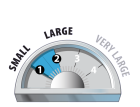
Loose snow avalanches may fail with human or solar triggers at alpine elevations.
Travel and Terrain Advice
- Avoid exposure to terrain traps where the consequences of a small avalanche could be serious.
- Choose routes that are not exposed to avalanches from above.
Avalanche Summary
There have been a several recent reports of remote-triggered (triggered from a distance) and naturally triggered persistent slab avalanches to size 2 on all aspects between 1400-2300m. Several loose dry and a few solar-triggered loose wet avalanches have also been reported.
Reactivity of the persistent slab is likely to increase with warmer temperatures as the upper snow becomes denser.
Snowpack Summary
Warming is starting to turn dry powder into a cohesive slab in some areas. The main troublemaker in the snowpack at the moment is a layer of feathery surface hoar down 50-70 cm, buried in mid-December. In places this interface exists as a crust/facet combo. It is most prevalent around treeline, but it may be more widespread in some locations. A little more warming, precipitation and/or wind-loading could be all that is needed to turn powder into an easy-to-trigger slab above this touchy interface. It's tricky to predict and even professionals are scratching their heads a bit about exactly when and where this beast will wake up. It's a good time for conservative decision-making.
Deeper in the snowpack (about 80-120 cm down), a rain crust from November remains in the back of our minds, but it is considered dormant for now. If you have any recent observations, please share them through the Mountain Information Network.
Weather Forecast
Thursday: Mix of sun and cloud, with flurries possible in the valleys. A layer of warm air is expected between 2000-2500m, while it remains cold in the valleys. Light variable winds.
Friday: Cloudy with flurries. Moderate southwesterly winds.
Saturday: Light snow (5-10 cm). Light to moderate south-westerly winds.
More details can be found in the Mountain Weather Forecast.
Avalanche Forecasts in your Inbox
Avalanche Canada has switched to an RSS feed for its daily forecasts. This is a much more flexible method that allows automatic delivery to your email inbox, or to an RSS reader of your choice.
What are RSS feeds?
RSS (Really Simple Syndication) is a popular standardized file format allowing up-to-date delivery of web-based content. RSS feeds enable you to receive content updates from websites, delivered to your email through an RSS aggregator (such as blogtrottr.com) or viewed through applications called RSS readers (such as feedly.com).
Set up an RSS feed for your email:
Select a RSS aggregator
- North Columbia URL:
http://www.avalanche.ca/api/forecasts/north-columbia.rss - Copy the url and paste it into the appropriate field of your RSS aggregator.
- Fill in your email address.
- Voila! Watch the Avalanche Canada forecast roll into your inbox.
Forecast Disclaimer
Avalanche Canada's Public Avalanche Bulletin, and other information and services provided by Avalanche Canada, are intended for personal and recreational purposes only.
**THIS INFORMATION IS PROVIDED "AS IS" AND IN NO EVENT SHALL THE PROVIDERS BE LIABLE FOR ANY DAMAGES, INCLUDING, WITHOUT LIMITATION, DAMAGES RESULTING FROM DISCOMFORT, INJURY, OR DEATH, CLAIMS BY THIRD PARTIES OR FOR OTHER SIMILAR COSTS, OR ANY SPECIAL, INCIDENTAL, OR CONSEQUENTIAL DAMAGES, ARISING OUT OF THE USE OF THE INFORMATION.**
The user acknowledges that it is impossible to accurately predict natural events such as avalanches in every instance, and uses the data in this bulletin with this always foremost in mind. The accuracy or reliability of the data is not guaranteed or warranted in any way and the Providers disclaim liability of any kind whatsoever, including, without limitation, liability for quality, performance, merchantability and fitness for a particular purpose arising out of the use, or inability to use the data.
Warming, particularly at treeline elevations, could turn powder into slabs which can fail on persistent weak layers.