Avalanche Forecast
Avalanche Bulletin - Jasper National Park

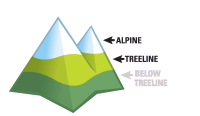
Good skiing remains on on sheltered and shaded slopes. Recent persistent slab activity is a sign that ski mountaineering season is not here quite yet.
Avalanche Problem 1: Persistent Slabs
What Elevation?
Which Slopes?

Chances of Avalanches?

Expected Size?

Travel and Terrain Advice
- Avoid shallow snowpack areas where triggering is more likely.
- Pay attention to overhead hazards like cornices which could easily trigger deep slabs.
Avalanche Problem 2: Wind Slabs
What Elevation?

Which Slopes?
Chances of Avalanches?
Expected Size?
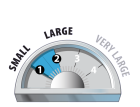
SW winds Saturday have added to the existing wind slab and cornice problem. Although mostly thin, some wind slabs are up to 40cm thick in alpine terrain. Once initiated the potential to trigger deeper weaknesses exists resulting in larger avalanches.
Travel and Terrain Advice
- Be careful with wind loaded pockets, especially near ridge crests and roll-overs.
- Stay well to the windward side of corniced ridges.
Avalanche Problem 3: Loose Wet
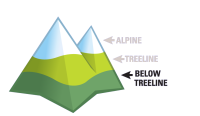
What Elevation?
Which Slopes?

Chances of Avalanches?

Expected Size?

Pay close attention to the effect of solar radiation and daytime warming. Point release from rocks and cliff terrain can trigger isothermal snow below. This will be of most concern in the late afternoon.
Travel and Terrain Advice
- Avoid exposure to terrain traps where the consequences of a small avalanche could be serious.
- Use extra caution on solar slopes or if the snow is moist or wet.
Avalanche Summary
Report of a large persistent slab avalanche (size 2.0) on the NE slopes of Lectern, initiating in the alpine and running in to treeline.
Last weeks avalanche activity is still visible in many location - a good reminder to avoid steep terrain that has not had recent avalanche activity (especially on Northerly aspects).
Snowpack Summary
Windslabs are up to 40cm deep. Sun or temperature crusts extend to treeline and continued into the alpine on southerly slopes. Persistent slabs can be found on most aspects at treeline and above. These have been most reactive recently to large triggers like cornice failures. Below 1,900m the snowpack is going isothermal on a daily basis.
Weather Forecast
A building ridge of high pressure brings a warming trend that likely marks the end of winter.
Sunday will be partly cloudy, with the freezing level rising to 1800m, an Alpine High of -4C, and light to moderate NW winds.
The warming trend begins in ernest Monday, with Clear skies forecast through the week, and the freezing level surpassing 3000m by Thursday.
Avalanche Forecasts in your Inbox
Avalanche Canada has switched to an RSS feed for its daily forecasts. This is a much more flexible method that allows automatic delivery to your email inbox, or to an RSS reader of your choice.
What are RSS feeds?
RSS (Really Simple Syndication) is a popular standardized file format allowing up-to-date delivery of web-based content. RSS feeds enable you to receive content updates from websites, delivered to your email through an RSS aggregator (such as blogtrottr.com) or viewed through applications called RSS readers (such as feedly.com).
Set up an RSS feed for your email:
Select a RSS aggregator
- Avalanche Bulletin - Jasper National Park URL:
http://www.avalanche.ca/api/forecasts/jasper.rss - Copy the url and paste it into the appropriate field of your RSS aggregator.
- Fill in your email address.
- Voila! Watch the Avalanche Canada forecast roll into your inbox.
Forecast Disclaimer
Avalanche Canada's Public Avalanche Bulletin, and other information and services provided by Avalanche Canada, are intended for personal and recreational purposes only.
**THIS INFORMATION IS PROVIDED "AS IS" AND IN NO EVENT SHALL THE PROVIDERS BE LIABLE FOR ANY DAMAGES, INCLUDING, WITHOUT LIMITATION, DAMAGES RESULTING FROM DISCOMFORT, INJURY, OR DEATH, CLAIMS BY THIRD PARTIES OR FOR OTHER SIMILAR COSTS, OR ANY SPECIAL, INCIDENTAL, OR CONSEQUENTIAL DAMAGES, ARISING OUT OF THE USE OF THE INFORMATION.**
The user acknowledges that it is impossible to accurately predict natural events such as avalanches in every instance, and uses the data in this bulletin with this always foremost in mind. The accuracy or reliability of the data is not guaranteed or warranted in any way and the Providers disclaim liability of any kind whatsoever, including, without limitation, liability for quality, performance, merchantability and fitness for a particular purpose arising out of the use, or inability to use the data.
Avoid travel on steep slopes that have not had recent avalanche activity. These events have been most reactive to large triggers, such as a cornice failure or smaller avalanche, but may be reactive to the weight of a skier in the wrong place.