Avalanche Forecast
Kananaskis Country, Alberta Parks

Dont be in big terrain that hasnt previously avalanched. Sheltered areas have good skiing but we need some snow for a good re-set.
Avalanche Problem 1: Wind Slabs
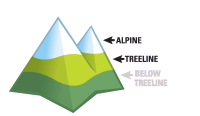
What Elevation?
Which Slopes?

Chances of Avalanches?

Expected Size?

Travel and Terrain Advice
- Be wary of slopes that did not previously avalanche.
- Use caution in lee areas. Recent wind loading has created wind slabs.
Avalanche Problem 2: Persistent Slabs
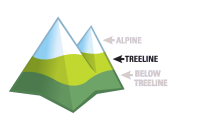
What Elevation?
Which Slopes?
Chances of Avalanches?
Expected Size?
The surface hoar is still intact in many treeline areas. It's depth varies, but a meter down is a good generalization. We are still treating this layer with caution and respect. Surface hoar is known for unexpected surprises.
Travel and Terrain Advice
- Dig down to find and test weak layers before committing to a line.
- Be wary of slopes that did not previously avalanche.
- Minimize exposure to overhead avalanche terrain, large avalanches may reach run out zones.
Avalanche Summary
Its hard to tell whats new and older as strong winds are filling in the fracture lines quickly. Of note, the Tryst Gully (commonly used after leaving tryst) has recently slid sz 2.5 with debris 2-4m deep in places. Some people had been using this gully as an approach earlier this winter and this avalanche is a sobering reminder of how much of a terrain trap this piece of terrain is. Just because you have (or someone else has) gone one way before, doesn't mean its safe.
Snowpack Summary
Light flurries throughout the day and overnight but only close to 5cm of accumulations. Moderate westerly winds continued building on the windslabs that previously existed. Alpine areas have extensive windslabs from the strong winds earlier in the week. Its not uncommon to find a drummy feeling as you approach more open terrain. At treeline the windslabs are more specific in nature such as along ridgelines and in gullies. A few prominent weak layers still exist at the base of the snowpack. The Dec 15th interface down 140cm and the January surface hoar layers down 100cm. Test resulst are still in the hard rnage on these layers but they are highly variable. Use caution in any areas that have not previously slid and minimize your exposure to overhead terrain.
Weather Forecast
Forecasts are calling for 5-10cm of new snow over the next 24hrs with generally light NW winds. Temperatures will be cool on Saturday and then FRIGID on Sunday! Dress warm!
Avalanche Forecasts in your Inbox
Avalanche Canada has switched to an RSS feed for its daily forecasts. This is a much more flexible method that allows automatic delivery to your email inbox, or to an RSS reader of your choice.
What are RSS feeds?
RSS (Really Simple Syndication) is a popular standardized file format allowing up-to-date delivery of web-based content. RSS feeds enable you to receive content updates from websites, delivered to your email through an RSS aggregator (such as blogtrottr.com) or viewed through applications called RSS readers (such as feedly.com).
Set up an RSS feed for your email:
Select a RSS aggregator
- Kananaskis Country, Alberta Parks URL:
http://www.avalanche.ca/api/forecasts/kananaskis.rss - Copy the url and paste it into the appropriate field of your RSS aggregator.
- Fill in your email address.
- Voila! Watch the Avalanche Canada forecast roll into your inbox.
Forecast Disclaimer
Avalanche Canada's Public Avalanche Bulletin, and other information and services provided by Avalanche Canada, are intended for personal and recreational purposes only.
**THIS INFORMATION IS PROVIDED "AS IS" AND IN NO EVENT SHALL THE PROVIDERS BE LIABLE FOR ANY DAMAGES, INCLUDING, WITHOUT LIMITATION, DAMAGES RESULTING FROM DISCOMFORT, INJURY, OR DEATH, CLAIMS BY THIRD PARTIES OR FOR OTHER SIMILAR COSTS, OR ANY SPECIAL, INCIDENTAL, OR CONSEQUENTIAL DAMAGES, ARISING OUT OF THE USE OF THE INFORMATION.**
The user acknowledges that it is impossible to accurately predict natural events such as avalanches in every instance, and uses the data in this bulletin with this always foremost in mind. The accuracy or reliability of the data is not guaranteed or warranted in any way and the Providers disclaim liability of any kind whatsoever, including, without limitation, liability for quality, performance, merchantability and fitness for a particular purpose arising out of the use, or inability to use the data.
The upper snowpack has several windslabs piled on top of each other. These slabs are up to 50cm thick in alpine terrain. Watch for failures in these slabs to step down to the deeper layers.