Avalanche Forecast
Kananaskis Country, Alberta Parks

Great skiing right now with the new snow. Sluffing is a real hazard and watch for localized wind slab development at higher elevations.
Avalanche Problem 1: Loose Dry
What Elevation?

Which Slopes?

Chances of Avalanches?

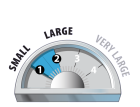
Expected Size?
Travel and Terrain Advice
- Be cautious of sluffing in steep terrain.
- The new snow will require several days to settle and stabilize.
- On steep slopes, pull over periodically or cut into a new line to manage sluffing.
Avalanche Problem 2: Wind Slabs
What Elevation?
Which Slopes?
Chances of Avalanches?

Expected Size?
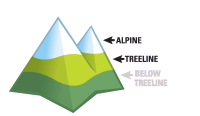
Both recently formed and recently buried wind slabs are present in the Alpine on all aspects, and in isolated spots at Treeline. With the increased snow load, these slabs are now more sensitive to triggering.
Travel and Terrain Advice
- Be careful with wind loaded pockets, especially near ridge crests and roll-overs.
- Avoid steep lee and cross-loaded slopes
Avalanche Summary
Loose dry avalanches continue to occur in steep terrain at all elevations and on all aspects. These slides are generally size 1.5 or smaller, but are running a far distance in some terrain features.
Snowpack Summary
Another 10 to 15cm of new snow overnight brings the storm snow total to 40 to 50cm. This snow is mostly still low density in nature except in the high Alpine and in wind prone areas. Expect to find slabs on all aspects in the Alpine that have either been recently formed, or formed earlier in the storm and are now buried. At Treeline and below the Dec 15th surface hoar layer is buried between 40 and 60cm deep and is failing in loose dry avalanches, but not yet as a slab due the lack of an overlying cohesive layer. With increased winds this could change. Recent snowpits are showing that the November crusts are faceting, but these layers have not been active as an avalanche problem.
Weather Forecast
Sunday will be sunny with cloudy periods and no new snow. Temperatures are finally beginning to moderate, and after another cold night the daytime high should be a comparably pleasant -13 °C at higher elevations. Ridge top winds will be out of the west at 15 km/h. As the week progresses temperatures will continue to moderate with highs near 0°C by Wednesday or Thursday.
Avalanche Forecasts in your Inbox
Avalanche Canada has switched to an RSS feed for its daily forecasts. This is a much more flexible method that allows automatic delivery to your email inbox, or to an RSS reader of your choice.
What are RSS feeds?
RSS (Really Simple Syndication) is a popular standardized file format allowing up-to-date delivery of web-based content. RSS feeds enable you to receive content updates from websites, delivered to your email through an RSS aggregator (such as blogtrottr.com) or viewed through applications called RSS readers (such as feedly.com).
Set up an RSS feed for your email:
Select a RSS aggregator
- Kananaskis Country, Alberta Parks URL:
http://www.avalanche.ca/api/forecasts/kananaskis.rss - Copy the url and paste it into the appropriate field of your RSS aggregator.
- Fill in your email address.
- Voila! Watch the Avalanche Canada forecast roll into your inbox.
Forecast Disclaimer
Avalanche Canada's Public Avalanche Bulletin, and other information and services provided by Avalanche Canada, are intended for personal and recreational purposes only.
**THIS INFORMATION IS PROVIDED "AS IS" AND IN NO EVENT SHALL THE PROVIDERS BE LIABLE FOR ANY DAMAGES, INCLUDING, WITHOUT LIMITATION, DAMAGES RESULTING FROM DISCOMFORT, INJURY, OR DEATH, CLAIMS BY THIRD PARTIES OR FOR OTHER SIMILAR COSTS, OR ANY SPECIAL, INCIDENTAL, OR CONSEQUENTIAL DAMAGES, ARISING OUT OF THE USE OF THE INFORMATION.**
The user acknowledges that it is impossible to accurately predict natural events such as avalanches in every instance, and uses the data in this bulletin with this always foremost in mind. The accuracy or reliability of the data is not guaranteed or warranted in any way and the Providers disclaim liability of any kind whatsoever, including, without limitation, liability for quality, performance, merchantability and fitness for a particular purpose arising out of the use, or inability to use the data.
Lots of recent snow is leading to sluffing in steep terrain at all elevations. Some of these slides are running surprisingly far. Ice climbers should be particularly cautious with this problem.